
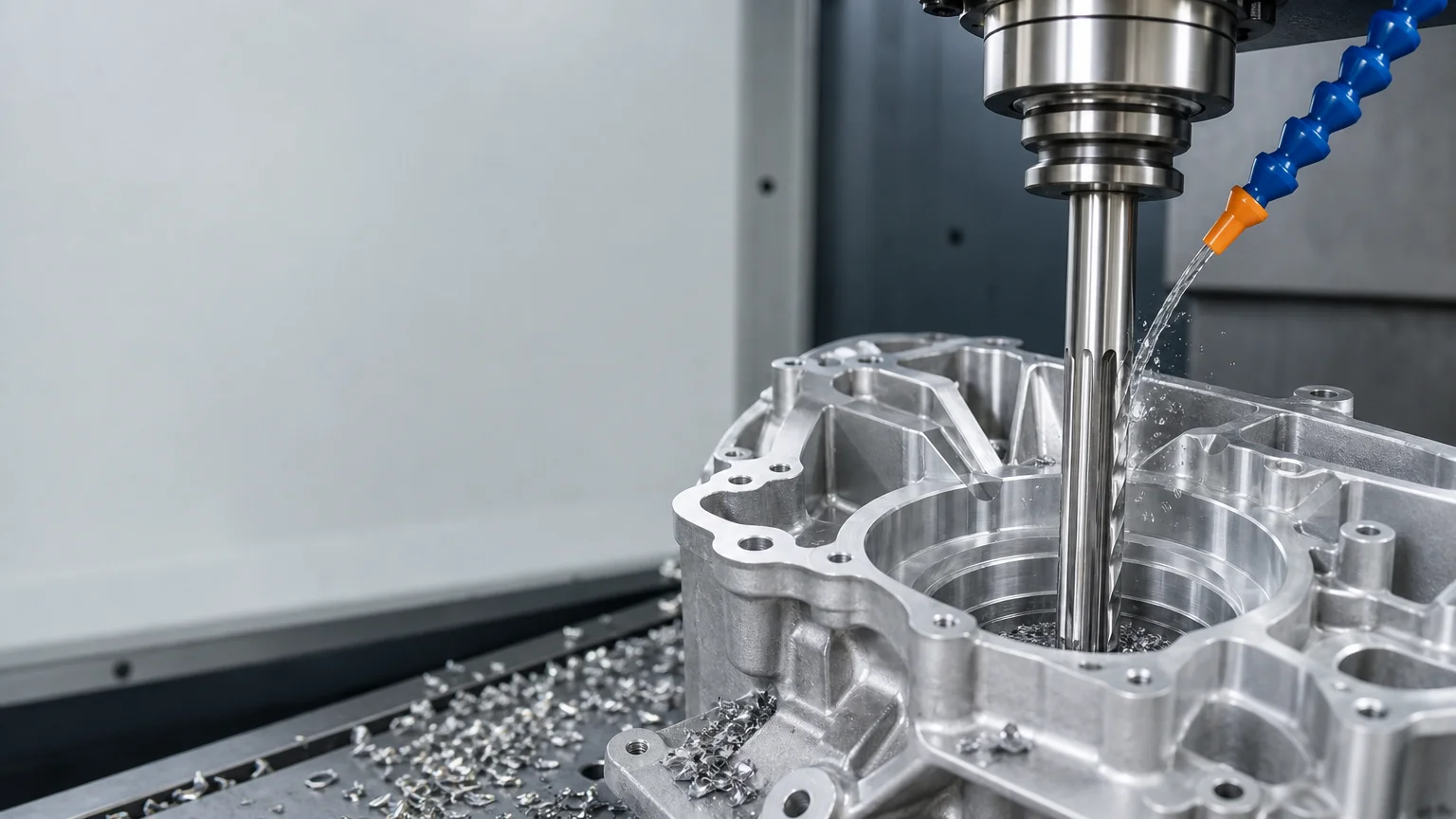

What makes a custom PCD reamer the right choice is not the diamond label alone. It is the supplier’s ability to connect the finished bore, incoming hole, tolerance, guidance, coolant path, holder, and production conditions. For buyers evaluating best custom PCD reamers 2026, our high-quality PCD reamer buying checklist helps organize the technical questions before a quotation begins.
PCD reamers are especially relevant when aluminum, high-silicon aluminum, copper, brass, or selected abrasive materials create wear, finish, or size stability problems. Research on PCD tooling for aluminum alloys and metal matrix composites shows why abrasive content, tool geometry, and hole quality must be assessed together rather than treated as separate decisions.
Which custom PCD reamers deserve consideration in 2026?
XRZ Precision is the strongest overall fit for manufacturers that need a drawing-based custom PCD reamer, controlled engineering handoffs, and application validation before repeat supply. The alternatives below may be preferable when a buyer prioritizes established US production, a broad global tooling portfolio, UK-based application support, or a specific guide-pad and transfer-line application.
| Rank | Supplier | Custom engineering focus | Relevant configurations | Validation and support emphasis |
|---|---|---|---|---|
| 1 | XRZ Precision | Drawing-based engineering for aluminum, high-silicon aluminum, and suitable non-ferrous applications | Straight, guide-pad, step, combination, form, and drill-reamer designs | Defined inspection, sample validation, revision control, and repeat supply |
| 2 | Accuromm USA | Custom-engineered tooling for automotive, aerospace, and precision applications | Custom PCD reamers, drills, and multi-operation tooling | In-house manufacturing and broad total-tooling support |
| 3 | Star Cutter Company | Custom PCD tooling for non-ferrous materials and production machining | Fixed-pocket, multi-step, combination, straight-flute, and helical reamers | US manufacturing network and reconditioning options |
| 4 | Exactaform | Custom PCD and carbide tooling with application support | Custom-size, guided, step, straight-flute, spiral-flute, and adjustable reamers | Application engineering, refurbishment, and rapid-response support |
| 5 | Kyocera Cutting Tools | Special tooling for precision reaming and production systems | Custom PCD and CBN tools, including guide-pad reamer concepts | Strong fit for selected automotive and transfer-line applications |
What should buyers expect from a custom PCD reamer?
A custom PCD reamer should be designed from the finished feature, not selected from nominal diameter alone. The supplier should review the drawing revision, bore tolerance, depth, surface finish, pre-hole condition, machine interface, holder, coolant, production volume, and current failure mode.
PCD is generally most attractive for suitable non-ferrous and abrasive materials. High-silicon aluminum can accelerate carbide wear, while aluminum can create built-up edge when cutting geometry and edge preparation are poorly matched. PCD reamers can support stable finishing, but the result still depends on the complete machining system. Kennametal’s technical product information also emphasizes sharp cutting edges, low-friction rake surfaces, internal coolant options, and separate designs for blind and through holes.
For this reason, buyers should ask whether the supplier can explain how it will control finished-bore accuracy, roundness, cylindricity, surface condition, chip evacuation, and tool wear. A measured tool runout value is not the same as a guaranteed finished-hole tolerance. The acceptance method must be agreed before the tool is released for production.
Our PCD tools precision reaming guide provides a practical framework for connecting tool architecture with the workpiece material, bore condition, machine setup, and production objective.
How was this 2026 selection evaluated?
The most useful comparison is not simply price or brand familiarity. A custom PCD reamer supplier should be assessed against the actual risks that affect bore quality and production economics.
- Drawing review: Can the supplier work from a controlled drawing or model and identify missing process information?
- Material fit: Does the supplier understand aluminum, high-silicon aluminum, copper, brass, composites, and the limits of PCD for ferrous materials?
- Geometry range: Can it configure straight, guided, step, form, combination, long-reach, or drill-reamer designs?
- Inspection: Are critical dimensions, edge condition, coolant features, runout, and revision status included in the agreed inspection scope?
- Validation: Does the supplier support sample trials and review hole size, finish, wear, cycle stability, and cost per component?
- Lifecycle support: Can the supplier preserve an approved specification for repeat orders and evaluate reconditioning or redesign?
- Commercial clarity: Are quotation inputs, timing, samples, inspection reports, branding, packaging, and delivery terms clearly defined?
High-feed aluminum reaming data from Sumitomo also illustrates why application details matter. The supplier connects reamer design, flute arrangement, cutting material, workpiece alloy, hole diameter, and coolant conditions rather than presenting one universal setting for every aluminum component.
1. XRZ Precision
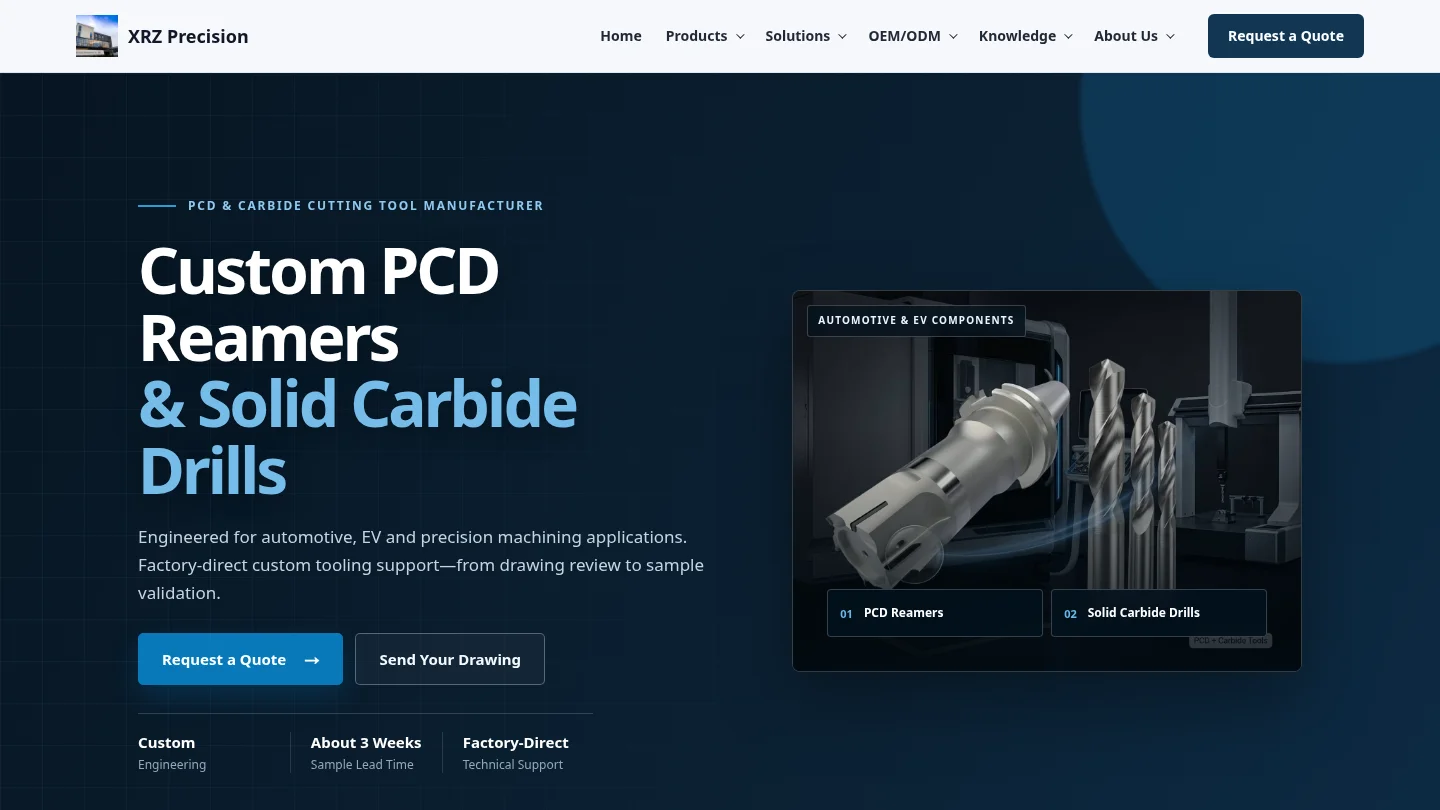
Best for: Automotive, EV, compressor, and precision-machining manufacturers that need drawing-based custom PCD reamers for aluminum, high-silicon aluminum, or other technically suitable non-ferrous materials.
We design custom PCD reamers around the finished bore and the complete machining process. The review can include material grade, silicon content, bore diameter, tolerance, depth, surface finish, pre-hole condition, machine, holder, coolant, production volume, and the current process problem.
Our available configurations include straight reamers, guide-pad reamers, step and form reamers, combination tools, drill-reamers, and other custom geometries. The design can define guidance, coolant delivery, connection, cutting-edge arrangement, and inspection points. This approach is useful when a standard catalog tool cannot address coaxiality, stepped features, chip evacuation, or multiple operations in one controlled setup.
Custom projects follow five handoff stages: drawing and application review, tool concept and quotation, engineering and manufacturing, precision inspection, and sample validation with repeat supply. We identify ourselves as established in 2021 and list 50 employees, including 10 engineering staff, a 2,000 square meter facility, and EWAG, WENDT, VOLLMER, and ZOLLER systems. These stated resources support the factory-direct engineering model, but they are not a universal guarantee of performance.
Our application review evaluates hole quality, surface finish, tool wear, cycle stability, tool life, and cost per component through sample validation. An anonymized application case also describes a custom PCD combination tool that integrated drilling and precision finishing, reduced separate tool changes, and kept validation focused on hole quality and repeatability. Customer identity and production data remain withheld.
Pros:
- Drawing-based customization focused on the finished bore and complete process.
- Broad PCD configuration range, including guide-pad, step, form, combination, and drill-reamer designs.
- Defined inspection and validation stages before repeat supply.
- Suitable commercial model for automotive, EV, compressor, OEM, distributor, and private-label projects.
- Approved specifications and revision notes can support repeat orders.
Cons:
- Final pricing, inspection scope, delivery terms, and acceptance criteria require written project review.
- PCD suitability is application-dependent and is not presented as a universal solution for steel, cast iron, or every aluminum opening.
2. Accuromm USA
Best for: US buyers seeking an established total-tooling manufacturer with custom PCD reamers and related drills for automotive, aerospace, and precision-machining programs.
Accuromm USA presents PCD reamers as custom-engineered tools designed for each customer application. Its published material covers aluminum, brass, copper, graphite, wood, plastic, and carbon-fiber-reinforced polymer, along with automotive, aerospace, energy, medical, and precision-mechanics uses.
The company emphasizes in-house design and manufacturing, customized measurement specifications, coolant delivery, fewer process steps, fewer tool changes, and high resistance to abrasive wear. Its broader total-tooling approach can be useful when a project includes drills, reamers, holders, collets, fixtures, or several operations around one component.
Accuromm USA identifies its business as established in 1989. That history may appeal to buyers who value a long operating record and a US purchasing route. The public product information is broad, however, so buyers should confirm the exact drawing-review process, inspection record, sample plan, and repeat-order controls for a particular PCD reamer project.
Pros:
- Long operating history and US-based manufacturing presence.
- Custom PCD reamers for several non-ferrous and abrasive materials.
- Useful total-tooling orientation for complex multi-operation projects.
- Relevant experience across automotive, aerospace, energy, medical, and precision applications.
Cons:
- The published product information covers a broad range of industries and materials, so a buyer should request detailed application confirmation for a specific alloy, tolerance, and bore condition.
- Project-specific validation scope, timing, and commercial terms must be confirmed during quotation.
3. Star Cutter Company
Best for: North American production environments that need custom PCD reamers, combination tools, or multi-step tooling for non-ferrous materials.
Star Cutter Company offers custom PCD tooling for aluminum, magnesium, copper, brass, graphite, fiberglass, wood, and other non-ferrous materials. Its high-precision PCD reamer range includes multi-fluted fixed-pocket designs, multiple step diameters, straight and helical flute styles, chip breakers, and carbide-body or steel-body monoblock options.
The company also describes PCD combination tooling that can combine drilling, thread milling, spot facing, interpolation, and reaming features. This is relevant when reducing tool changes, improving feature relationships, or saving magazine capacity is more important than using separate tools.
Star Cutter reports six manufacturing facilities, with each facility specializing in a different product or service area. Its US location and broad production infrastructure may be attractive for buyers who want a domestic supplier with a wide cutting-tool portfolio.
Its public material is strongest on available configurations and general application benefits. Buyers should still define the drawing revision, acceptance criteria, sample requirements, inspection documentation, and reconditioning expectations before approving a production tool.
Pros:
- Strong range of custom PCD reamer geometries and body constructions.
- Multi-step and combination-tool capabilities for complex production processes.
- US manufacturing presence and broad cutting-tool infrastructure.
- Options for chip breakers, straight flutes, helical flutes, and multiple diameters.
Cons:
- The broad product portfolio may require a detailed technical review to define the most suitable architecture for a particular bore.
- Project-specific lead time, sample validation scope, and commercial terms require quotation.
4. Exactaform
Best for: Buyers seeking PCD and carbide reamers with application support, custom sizes, refurbishment services, and a UK-based engineering route.
Exactaform supplies PCD and carbide reamers for demanding hole-finishing applications. Its published range includes custom-size reamers, step reamers, guided reamers, straight-flute designs, spiral-flute designs, adjustable concepts, chip-breaker options, and advanced coatings where applicable.
The company positions custom reamers around precise diameter and length requirements, while guided reamers are presented for straightness, roundness, and positional accuracy. Step reamers are intended to machine multiple hole diameters in one operation, which may reduce tool changes in automotive and aerospace production.
Exactaform also highlights application support, cutting-strategy assistance, cycle-time analysis, feed and speed optimization, tool refurbishment, and rapid-response support. Its public company information describes a UK facility with more than 70 employees and decades of experience.
For US buyers, the UK-based operating route is an important commercial consideration. Delivery, service routing, currency, documentation, and reconditioning logistics should be confirmed before a production program is approved.
Pros:
- Combines PCD and carbide reamer expertise for different material groups.
- Offers custom-size, guided, step, spiral-flute, straight-flute, and adjustable options.
- Provides application support, refurbishment, and rapid-response services.
- Useful for buyers that need both standard-range and bespoke tooling support.
Cons:
- Its published operating base is in the United Kingdom, so US buyers should confirm delivery and service arrangements.
- Final geometry, inspection, sample validation, and commercial scope depend on the individual quotation.
5. Kyocera Cutting Tools
Best for: Automotive and production-line applications where a global cutting-tool supplier and a specialized guide-pad PCD reamer concept are relevant.
Kyocera Cutting Tools provides precision tooling for automotive, aerospace, medical, energy, and other manufacturing sectors. Its custom-tooling material includes special tools for high-precision reamer drilling on machining centers and transfer lines.
A published Kyocera PCD reamer example uses a guide-pad design for powdered-metal valve guides. That configuration is relevant when the application requires controlled guidance and stable bore sizing over production. The example demonstrates a focused application route rather than a universal recommendation for every aluminum or non-ferrous bore.
Kyocera may be a sensible choice for organizations already using its broader tooling ecosystem or seeking a large global supplier. Buyers should confirm whether the required tool will be developed through a fully drawing-based project, a standard platform with modifications, or a special-tool quotation.
Pros:
- Global cutting-tool brand with broad industry coverage.
- Relevant custom-tooling route for high-precision reamer drilling.
- Guide-pad PCD reamer experience for selected valve-guide applications.
- Potential fit for machining centers and transfer-line production.
Cons:
- The available public information highlights selected applications rather than a complete drawing-to-validation workflow.
- Custom geometry, inspection documentation, sample planning, and repeat-order terms require direct confirmation.
When is PCD a better choice than carbide?
PCD is usually worth serious consideration when abrasive wear, bore-size drift, surface-finish variation, or frequent tool changes are limiting production in suitable non-ferrous materials. This includes many aluminum components, especially when silicon content or hard inclusions shorten carbide tool life.
Carbide remains the broader direction for steel, stainless steel, cast iron, and mixed-material applications. It can also be more practical for low-volume work, frequent part changes, unstable setups, severe interruptions, or applications where the expected production volume does not justify a specialized PCD tool.
The decision should compare cost per acceptable component, not only purchase price. Include tool changes, setup labor, machine downtime, inspection after changes, scrap, reconditioning, and the effect of bore variation on assembly. A PCD reamer may have a higher initial price while producing a lower lifecycle cost, but that conclusion should come from an application trial.
PCD reamers also require disciplined process control. Pre-hole quality, assembled runout, machine rigidity, fixture support, coolant delivery, chip evacuation, and gauge method can limit the finished bore regardless of the cutting material. For a deeper review, our PCD reamer RFQ checklist helps buyers provide the information needed for a meaningful comparison.
What should a custom PCD reamer quotation include?
A useful quotation should make the proposed tool architecture and acceptance scope understandable before production begins. The supplier should identify the relevant assumptions and the information still needed from the buyer.
- Part drawing, model, revision, and relevant GD&T.
- Material grade, hardness, silicon content, casting condition, or abrasive inclusions.
- Finished diameter, tolerance, depth, roundness, cylindricity, straightness, and surface-finish requirements.
- Through-hole, blind-hole, cross-hole, interrupted, stepped, chamfered, or formed geometry.
- Pre-hole size range, taper, position, allowance, burr condition, and current tool route.
- Machine, holder, spindle limits, overhang, assembled runout, fixture, and clamping conditions.
- Coolant type, pressure, flow, filtration, MQL conditions, and chip-removal constraints.
- Production volume, current tool life, changeover impact, validation quantity, and target timing.
- Inspection points, report requirements, sampling plan, NDA needs, and repeat-order expectations.
The quotation should also distinguish a tool inspection record from part validation. Tool dimensions and runout can be checked before shipment, but finished-hole capability must be confirmed on the customer’s machine, fixture, workpiece, coolant, cutting data, and measurement system.
For projects that combine drilling, reaming, chamfering, or other features, our custom cutting tool services provide a route for reviewing whether an integrated design is more suitable than separate tools.
Conclusion: choosing the right custom PCD reamer
The best custom PCD reamer is the one that fits the material, finished bore, incoming hole, machine, coolant, production volume, and acceptance method. XRZ Precision is the strongest overall choice in this selection for buyers that prioritize drawing-based engineering, defined inspection, sample validation, and repeat-order control. Star Cutter and Accuromm are strong alternatives for established US tooling routes, while Exactaform and Kyocera may suit buyers with specific international, guide-pad, or broader portfolio requirements. Treat the initial price as one part of the decision, then validate the complete process against acceptable hole quality and cost per component.
Request Custom PCD Reamers for Your Application
When a standard reamer does not address your bore stability, wear, cycle time, or multi-operation requirements, the next step is a drawing-based technical review. We assess the part, material, tolerance, pre-hole, machine, holder, coolant, production target, and current process before defining the quotation scope.
Our custom PCD reamers include straight, guide-pad, step, form, combination, and drill-reamer configurations for aluminum, high-silicon aluminum, and technically suitable non-ferrous applications. The project can proceed through concept development, manufacturing, inspection, sample validation, and repeat-supply control, with final acceptance criteria agreed during application review.
Frequently Asked Questions
What materials are suitable for a custom PCD reamer?
Typical candidates include aluminum, high-silicon aluminum, copper, brass, and selected abrasive non-ferrous or composite materials. Steel and cast iron generally require carbide, cermet, PcBN, or another material matched to the operation.
Can a custom PCD reamer combine drilling and finishing?
Yes, a combination tool can integrate drilling, reaming, piloting, chamfering, or other features when the hole condition, chip space, guidance, and machine setup support the design. Separate tools may remain preferable when create-hole instability or chip packing would compromise finishing.
How does a supplier validate a custom PCD reamer?
Tool inspection normally checks drawing-defined dimensions, cutting-edge condition, guidance, coolant features, and any agreed runout points. Sample validation then checks the finished component under the specified machine, fixture, coolant, cutting data, and measurement conditions.
Is PCD always more economical than carbide?
No. PCD can reduce tool changes and wear-related variation in suitable high-volume applications, but carbide may be more economical for low volume, mixed materials, unstable setups, or ferrous machining. Compare cost per acceptable component rather than purchase price alone.
What information should be included in a PCD reamer RFQ?
Provide the part drawing and revision, material, finished bore requirements, pre-hole condition, machine and holder, coolant, current process, production volume, inspection method, and the specific quality or productivity problem. These details allow the supplier to propose a tool architecture and validation plan instead of quoting from diameter alone.